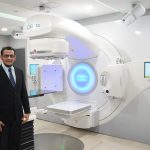
According to the Malaysia National Cancer Registry 2012- 2016, prostate cancer ranks third in terms of the incidence among adult males. The registry also noted an increased number of males presented at an advanced stage of disease (Stage 4) in comparison to a previous time period (2007-2011). As such, screening is recommended for Malaysian men aged 50 and older in order to identify the disease at an early, treatable stage (see Prostate Cancer Screening Recommendations below).
Radiotherapy has been very well established as one of the treatment options for prostate cancer. Radiotherapy is a locally focused, non-surgical curative intervention that is highly effective for prostate cancer in its early stages. It has a comparable cure rate to prostatectomy, with additional benefit of having minimal impact on urinary continence and fewer long-term sexual adverse effects.
One modality of high precision radiotherapy is the stereotactic body radiation therapy (SBRT), which administers substantial daily radiation doses to the prostate with fewer treatments compared to traditional radiotherapy. To achieve this, modern imaging modalities like multiparametric magnetic resonance imaging (mpMRI) and prostate specific membrane antigen-positron emission tomography (PSMA-PET) are used in combination with state-of-the-art SBRT planning, imaging and treatment delivery technology. By optimizing radiation dose delivery to prostate cancer cells, cure rates can be enhanced while doses to healthy tissues are minimized. Consequently, treatment-related toxicity and adverse effects can be substantially reduced.
SBRT has been shown to be safe and effective in treating prostate cancer in several studies, with safety and efficacy rates similar to traditional radiation therapy methods. SBRT eliminates cancerous tissue with only five treatments administered over a period of 1 week. The expedited timetable is attractive to patients as it offers greater convenience than the conventional radiation regimen, which necessitates daily treatments for a duration of 5 to 8 weeks. Many studies employing SBRT reported that patients with low-risk, intermediate-risk, and high risk localized prostate cancer had 5-year biochemical (prostate specific antigen, PSA) progression-free survival rates of 95 percent, 84 percent, and 81 percent, respectively. Fatigue, urinary and bowel irregularities, and fatigue are frequent adverse effects of SBRT for the prostate that are typically reversible and transient in nature.

There is a subset of patients with a restricted number of detectable metastases (1–5 sites, predominantly bone and nodal metastases), known as oligometastatic prostate cancer. In these patients, SBRT targeted at prostate cancer and metastases identified by PSMA-PET scan has the potential to be a curative treatment option. Additionally, SBRT can be combined with systemic therapies such as hormone therapy and chemotherapy to effectively eliminate micrometastases. SBRT exhibits considerable potential as a salvage treatment alternative for intraprostatic recurrence following conventional radiotherapy as well as prostate bed recurrence following prostatectomy.
The UK ProtecT (Prostate testing for cancer and Treatment) trial established that survival from clinically localized prostate cancer remains very high over a median of 15 years (about 97 percent), irrespective of treatment allocation ie, active monitoring, radical prostatectomy or radical radiotherapy. Therefore, the choice of therapy involves weighing the pros and cons of each treatment against the individual patient’s needs. [New Engl J Med 2023.DOI: 10.1056/NEJMoa2214122]
SBRT’s toxicity versus surgery for localized prostate cancer was established in the PACE-A trial, where at 2-years post procedure, patients receiving SBRT reported better urinary continence and less sexual bother compared with those who underwent surgery. However, SBRT patients reported more bowel bother symptoms than surgery patients. [J Clin Oncol 2023;41(6):S298] SBRT was compared to traditional radiotherapy in the PACE-B trial and the efficacy were equivalent between the two arms (around 95 percent at 5 years) with similar toxicity [Int J Radiat Oncol Biol Phys. 2023;117(4): e2-e3]., The investigators concluded, taking PACE-A and B together, that SBRT should be the new standard of care for low and intermediate risk localised prostate cancer. Patients being offered surgery should be given information from these trials before deciding on treatment options.
In conclusion, SBRT is an established, high precision radiation treatment modality for early stage and advanced prostate cancer. With the availability of the highly sophisticated linear accelerator radiotherapy systems in Malaysia, this gives hope for prostate cancer patients and their families of greater chance of cure and better quality of life after treatment with SBRT. This is certainly the expectations of cancer patients of the 21st century.
Prostate Cancer Screening Recommendations for Malaysian / Asian men
For Malaysian men, the ideal recommendation for prostate cancer screening emphasizes individualized decision-making starting between ages 45 and 50, depending on personal risk factors. While Malaysian / Asian men statistically have a lower incidence of prostate cancer compared to other ethnic groups, they are more likely to be diagnosed at an advanced stage due to historically lower screening rates.
- Starting Age:
- Age 50: Standard starting age for average-risk men.
- Age 40–45: Earlier screening is recommended for those with a strong family history (first-degree relative diagnosed before age 65) or known genetic mutations like BRCA1/BRCA2.
- Primary Test: The PSA (Prostate-Specific Antigen) blood test remains the gold standard. A Digital Rectal Examination (DRE) is often used as an adjunct but not as the sole screening method.
- Screening Intervals:
- Every 2–4 years: Recommended for men aged 50–69 with stable PSA levels.
- Baseline PSA < 2.0 ng/mL: Studies in Chinese populations suggest a longer retest interval (e.g., every 6 years) may be safe for men in this low-risk category.
- Higher Baseline PSA: Men with PSA levels between 3.0–3.9 ng/mL should consider more frequent testing, such as every 2 years.
- Biopsy of the prostate gland to rule out prostate cancer: most commonly done through a TransRectal Ultrasound (TRUS) guided technique, ideally combined with an MRI-guided approach. Generally recommended once the serial PSA level rises above 4.0 ng /mL and before it reaches 10 ng/mL, in men undergoing prostate cancer screening.
Typical progression of prostate cancer diagnosis to treatment:
Screening; involves prostate-specific antigen (PSA) blood test, digital rectal examination (DRE).
Diagnosis; PSA, transrectal ultrasonography, prostate biopsy, histopathology and Gleason Score, pelvic computed tomography (CT), multiparametric MRI (mpMRI), radionuclide bone scan, Prostate-Specific Membrane Antigen (PSMA)-PET scan.
Grading and staging; determines the best treatment pathway.
Treatment options; surgery, radiation therapy, hormone therapy, chemotherapy, targeted therapy, and immunotherapy.