When cancer is discussed in medical settings, the focus is often on treatments, survival rates, and new technologies. But for many Malaysians, the hardest part is not just the disease, it’s everything else that comes with it. The stark truth is that the emotional, financial, and social challenges of cancer are not adequately addressed in clinical encounters, even though they shape the everyday realities of affected individuals and their families.
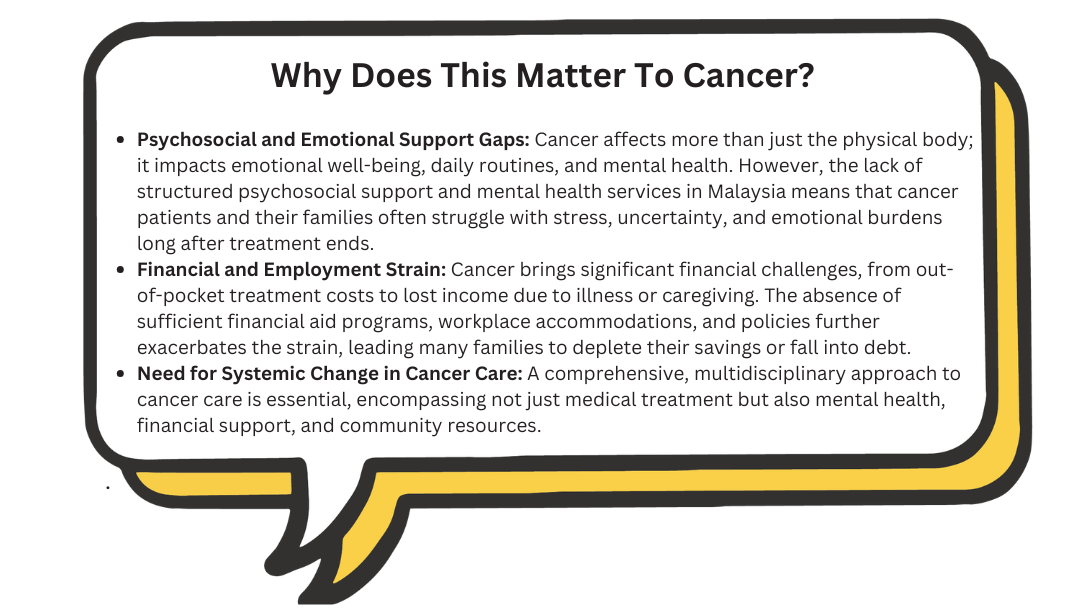
Central to this discussion is that cancer is not merely a medical condition as it disrupts every aspect of a person’s life. While it recognised that some hospitals and non-governmental organisations (NGOs) offer psychosocial support programs, which address emotional well-being and practical challenges after cancer, these efforts are neither programmatic nor sustainable. Cancer NGOs mostly rely on external donations, while public hospitals depend on ad hoc collaborations instead of a dedicated funding stream.
For many individuals, the lack of structured psychosocial support means that even simple decisions such as what to eat or when to resume daily activities become overwhelming. Without access to adequate informational support and practical guidance, this uncertainty can lead to stress and withdrawal, making it harder to regain confidence in daily routines. Cancer also affects sexuality and intimacy, but it is rarely discussed. Beyond the physical challenges, the emotional toll of cancer lingers long after treatment ends. Fear of recurrence haunts many, with every scan or unexpected symptom triggering anxiety. Yet, mental health support remains scarce as psychological services are presently not a standard part of cancer care in Malaysia. Encouragingly, some hospitals have begun incorporating psychosocial services into oncology settings but much more needs to be done to ensure equitable access.
Stigma adds another layer of burden, affecting both individuals and families. In some communities, cancer is seen as misfortune, weakness or even personal failure. This stigma extends into the workplace, where assumptions about reduced productivity lead to exclusion, even for those ready to work. The lack of workplace accommodations, inflexible policies, and unsupportive environments further hinder reintegration. Caregivers too, find it hard to return to work after long caregiving breaks with few employers offering meaningful support. However, global examples like flexible work arrangements and employer-supported reintegration programs show that workplace inclusion is not only possible but beneficial for all involved.
Cancer also threatens the financial stability of affected households. Even in public hospitals, families struggle with out-of-pocket costs for transport, supportive care items such as wigs and medical aid, and caregiving. In private settings, expenses can reach hundreds of thousands of ringgit forcing many families to deplete their savings, sell assets, or take loans. At the same time income loss adds to the strain. Affected individuals may take prolonged leave, reduce working hours or leave their jobs entirely due to treatment effects or caregiving duties. While some local NGOs have stepped in to offer financial aid, these efforts remain largely fragmented and underfunded.
Cancer care extends beyond oncology teams and requires a multidisciplinary approach, involving rehabilitation specialists, mental health professionals, social workers, and patient navigators. While oncologists and primary care providers may not directly offer psychosocial services, all members of the healthcare team must recognize psychosocial distress, be aware of available resources, and help patients navigate support systems. This includes screening for distress, guiding patients on workplace rights and financial support, and connecting them to community-based networks through open, non-judgmental discussions.
Importantly, improving cancer care in Malaysia warrants urgent systemic solutions including policies and funding to build a multidisciplinary cancer care workforce, strengthening workplace protections to ensure that individuals affected by cancer are not unfairly disadvantaged in employment, and expanding patient navigation programs that include financial services and structured support systems for caregivers and families. At present, patient navigation programs have been piloted and initiated primarily for breast cancer in selected public hospitals in the country. With better fiscal support, these programs could be expanded to more hospitals and broadened to cover a wider range of services and other cancers as well.
There is also a critical need to mobilize community resources, engage the private sector, and bring in non-traditional health partners to tackle psychosocial challenges. Employers, civil society, and patient advocacy groups all have a role to play. From workplace re-entry programs to financial navigation services and peer support networks, we need collaborative, locally driven solutions. Companies should recognize that accommodating employees affected by cancer is not just a moral responsibility but also a long-term investment in workforce retention and productivity.
Awareness-building is key. Many existing resources remain underutilized simply because people do not know that they exist. Healthcare professionals, community leaders, and businesses must work together to connect people to these services and co-design practical, community-based solutions that address the real-world challenges faced by those affected by cancer. The solutions we need are not just about policy, they are about ensuring real, on-the-ground change.
At the heart of this, a shift is needed from a siloed, hospital-centric approach that long has been the norm, to a model that truly supports people living with and beyond cancer holistically. Such an approach not only improves quality of life at the individual level but also reduces unnecessary healthcare utilisation, decreases dependency on social support systems, enables those affected to return to work and boosts workforce productivity. Therefore, policymakers must recognise that investing in comprehensive cancer care is not just a moral obligation but a strategic decision that strengthens the economy, supports the workforce, and ensures a more resilient society.
Dr Nirmala Bhoo-Pathy is a public health medicine specialist in Universiti Malaya Medical Centre, and professor of clinical epidemiology in Faculty of Medicine, Universiti Malaya